I am an econometrician working on sensitivity analysis and causal inference. Alongside the theory, I write open-source software and my research also extends to applied microeconomics.
I am on the 2026–2027 job market.
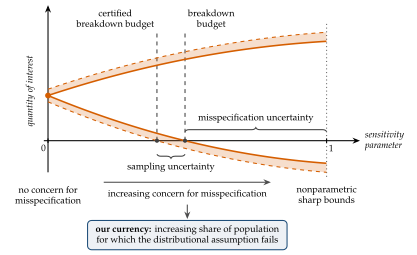
Abstract
Empirical work often relies on assumptions on the distribution of random variables, such as potential outcomes or latent variables, to identify some parameter of interest. We introduce a unified framework for assessing the sensitivity of a target estimand to relaxing these distributional assumptions for a given share of the population. We derive bounds on the values the estimand can take as this share varies between 0 and 1, and compute the bounds using tractable finite-dimensional programs. We propose plug-in estimators for the bounds and characterize their large sample properties. We also show that our bounds recover exact nonparametric sharp bounds at no additional computational cost, and introduce summary measures that separate misspecification uncertainty from sampling uncertainty and rank studies by their robustness. We apply our framework to assess the robustness of (i) average treatment effects in randomized experiments with attrition, (ii) counterfactual predictions in structural models, and (iii) formula instruments. We provide R and Python packages implementing all our methods.
Working Papers
Summary
Standard bandit algorithms for online policy learning assume the reward is always observed, but in many applications—such as gauging satisfaction through voluntary review prompts—feedback is missing in ways correlated with the outcome. In this regime, I show that the classic UCB algorithm selects suboptimal policies, and introduce a nonparametric Doubly-Robust UCB algorithm that models the missingness through covariates. I show that the newly proposed algorithm achieves near-optimal worst-case regret by means of new high-probability bounds for a class of doubly-robust estimators.
Summary
Empirical work leveraging regression discontinuity designs routinely examines how treatment effects vary with pretreatment covariates, yet the most common practices are not backed up by formal results. We develop a unified, theoretically grounded framework built on a fully interacted local-linear model, with principled bandwidth selection and robust bias-corrected inference for estimating heterogeneous effects and testing differences across groups.
Summary
We introduce rdhte, a package implementing our framework for heterogeneous treatment effects in RD designs.
Publications and Forthcoming
Summary
Using a regression discontinuity design on Italy’s largest firm-subsidy program (Law 488/92), we show that investment subsidies raised a firm's investment, employment, and survival probability. Both objective eligibility rules and local politicians’ discretion selected firms that went on to create more jobs, but discretion did so at a higher cost per job: allocating on objective rules alone would lower the cost per job by 11%, while relying on political discretion alone would raise it by 42%.
Summary
We develop prediction intervals that quantify the uncertainty of synthetic control predictions when multiple treated units and staggered adoption of treatment are involved. We provide precise non-asymptotic coverage guarantees and a careful taxonomy of the causal quantities one may target.
Summary
We introduce scpi, a package implementing our framework for uncertainty quantification in synthetic controls.
Summary
Deferring systems let a machine-learning model hand difficult cases to a human expert, yet their effect on accuracy is usually judged only by looking at the final human–AI performance. We instead propose a novel framework to evaluate the causal impacts on predictive accuracy of introducing a deferring system.
Summary
We explain how pretreatment covariates can be used in regression discontinuity designs: to improve the efficiency; to uncover heterogeneous policy effects; to change the RD parameter of interest.
Summary
The regression discontinuity estimand is local in nature. I introduce the package getaway, which implements the Angrist–Rokkanen (2015) method to extrapolate RD treatment effects away from the cutoff under an unconfoundedness assumption. I extend their framework to multi-cutoff designs, propose a data-driven algorithm to select covariates that satisfy such condition, and a toolkit for falsification of the identifying assumptions and visualization.
Summary
How long migrants choose to stay abroad is linked to their earnings in ways that need not be monotonic. Using recent documented Mexican immigrants, we document a U-shaped relationship between earnings and the intention to settle permanently in the U.S.. We then estimate a dynamic life-cycle model that rationalizes this feature of the data, and use the model to study how changes in Mexican earnings and U.S.–Mexico purchasing-power parity reshape return plans and savings.
Summary
Exploiting the allocation of subsidies in a large Italian investment-subsidy program (Law 488/92) as a regression discontinuity design, we estimate that subsidies raised the investment of marginal firms by 39% and their employment by 17% over six years. The gains are heterogeneous: smaller firms grow employment fastest, but larger and younger firms create more jobs per euro of public spending.
Software







Teaching
Description
A master’s-level introduction to econometric methods for program evaluation and causal inference, with a focus on methodology and implementation. Topics include randomized experiments, linear and nonlinear regression, uncertainty quantification and resampling, nonparametric smoothing methods, selection on observables, instrumental variables, regression discontinuity, and difference-in-differences and synthetic controls. The class uses R as statistical software.
Description
The objective of this course is to prepare students for basic empirical work in economics. In particular, topics will include basic data analysis, regression analysis, testing, forecasting, and causal inference. Students will be provided with the opportunity to use actual economic data to test economic theories. The class uses STATA as statistical software.